






Most UK Smokers Now Wrongly Believe Vaping Is as Harmful as Smoking
More than half of smokers in the United Kingdom now believe vaping is as harmful as—or more harmful than—smoking cigarettes, according to new survey findings from Action on Smoking and Health.
The results reveal a significant gap between public perception and the relative-risk guidance provided by the National Health Service. While vaping is not risk-free, the NHS continues to advise that nicotine vaping is less harmful than smoking and can be an effective tool for adults trying to quit cigarettes.
This growing misunderstanding may have serious public-health consequences. If smokers believe vaping and smoking carry the same level of risk, they may be less willing to switch completely away from combustible tobacco.
What Did the 2026 ASH Survey Find?
Action on Smoking and Health commissioned YouGov to survey more than 13,000 adults as part of its 2026 Smokefree GB research.
According to a July 5, 2026, Guardian report, the survey found that:
- 54% of UK adults believed vaping was as harmful as or more harmful than smoking.
- 52% of current smokers held the same belief.
- The figure increased to 61% among smokers who had never tried vaping.
These findings indicate that inaccurate risk perceptions are no longer limited to a small section of the population. They have become the majority view among both the general public and people who currently smoke.
Featured Snippet Answer
Is vaping as harmful as smoking?
No. According to the NHS, nicotine vaping is less harmful than smoking because it exposes users to fewer toxins and at lower levels. However, vaping is not harmless, its long-term effects are not fully understood, and children and non-smokers should not vape.
The Misconception Is Not New
The 2026 figures appear to continue a longer trend rather than represent a temporary change in public opinion.
ASH’s 2025 adult vaping fact sheet found that 53% of smokers believed vaping was as harmful as or more harmful than smoking. The same report estimated that approximately 10% of adults in Great Britain vaped, representing around 5.5 million people.
It also found that 55% of current vapers were former smokers.
This last figure is important because it suggests that vaping is frequently used as a substitute for smoking rather than simply as an additional recreational nicotine product. However, the benefits depend heavily on smokers switching completely instead of continuing to use both cigarettes and vapes.
Why Smoking and Vaping Do Not Carry the Same Risk
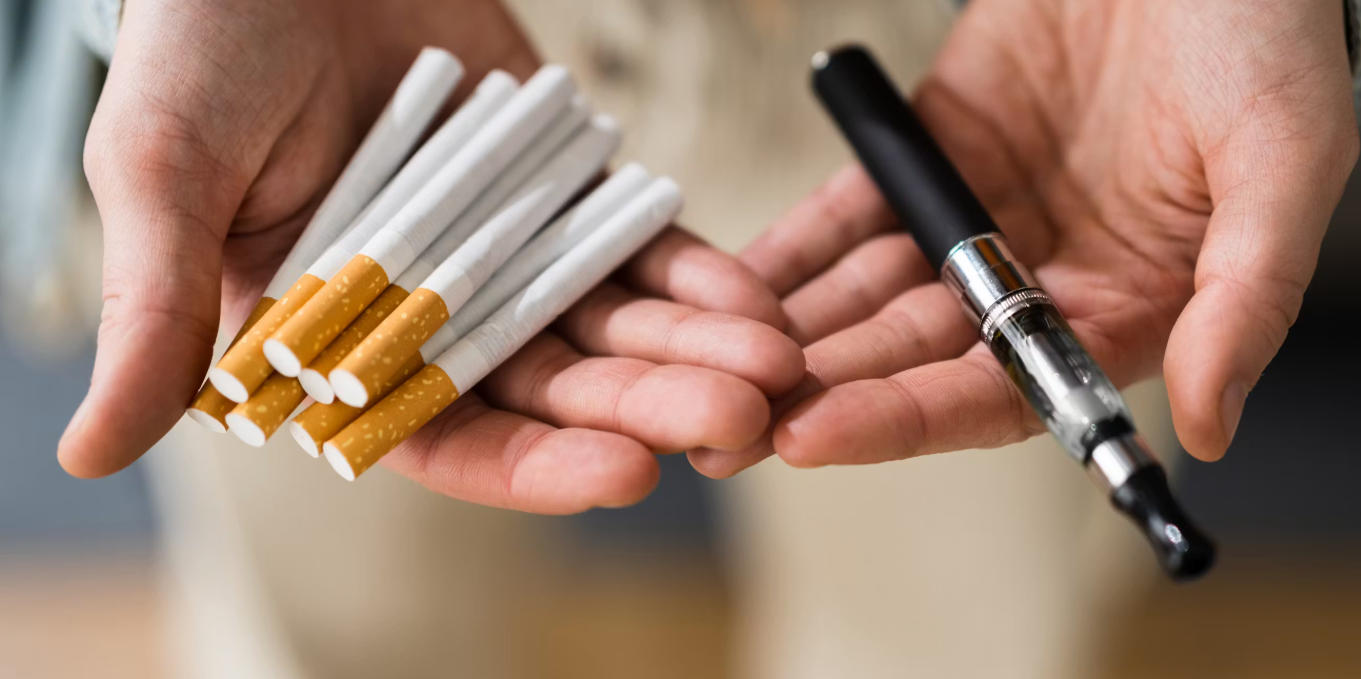
Smoking and vaping deliver nicotine in fundamentally different ways.
A cigarette burns tobacco. This combustion process produces smoke containing tar, carbon monoxide and thousands of chemicals. Many of these substances are toxic, and some are known to cause cancer.
A vape heats an e-liquid to produce an aerosol. Because tobacco is not burned, users are not exposed to the same mixture of combustion products found in cigarette smoke.
| Risk factor | Cigarette smoking | Nicotine vaping |
|---|---|---|
| Burns tobacco | Yes | No |
| Produces smoke | Yes | No |
| Produces tar | Yes | Not through tobacco combustion |
| Produces carbon monoxide | Yes | Generally not at cigarette-smoke levels |
| Contains nicotine | Usually | Usually |
| Can cause dependence | Yes | Yes |
| Risk-free | No | No |
| NHS assessment | Highly harmful | Less harmful than smoking |
The difference does not mean vaping is safe. It means that the two products should not be treated as equally harmful.
The NHS states that vaping exposes users to fewer toxins and at lower levels than smoking cigarettes. It also describes nicotine vapes as one of the most effective tools available for quitting smoking. NHS vaping guidance
What Does the Scientific Evidence Say?
A major evidence review published in 2022 examined the health risks and toxicant exposure associated with nicotine vaping in England.
The review was commissioned by the Office for Health Improvement and Disparities and conducted by researchers led by King’s College London.
It found that:
- Biomarkers of toxicant exposure were generally substantially lower among people who vaped than among people who smoked.
- Vaping was expected to pose only a small fraction of the risks of smoking over the short and medium term.
- Long-term evidence remained limited.
- Vaping should not be described as risk-free.
- Public-health messages must distinguish between the risks to non-smokers and the relative risks faced by existing smokers.
The review also warned that communication intended to discourage youth vaping should be designed carefully. Messages that exaggerate or remove the comparison with smoking could unintentionally mislead adult smokers.
Why Risk Perception Matters for Smokers
A smoker’s understanding of relative risk can influence whether they try vaping as a quitting tool.
If someone believes vaping and smoking are equally dangerous, switching may appear pointless. A smoker may instead:
- Continue smoking cigarettes
- Avoid trying vaping as a cessation tool
- Return to smoking after previously switching
- Continue using both products
- Distrust public-health advice
- Delay a quit attempt
The most important health objective is to stop smoking completely. A person who does not want to vape can use other evidence-based methods, including nicotine-replacement therapy, prescription medicines and local stop-smoking services.
However, smokers should make that decision using accurate comparative-risk information.
Is Nicotine the Main Cause of Smoking-Related Disease?
Nicotine is the primary substance that makes cigarettes and many vaping products addictive, but it is not the main cause of smoking-related cancer and lung disease.
Much of the severe harm caused by cigarettes comes from inhaling chemicals produced when tobacco burns.
This distinction is the basis of nicotine-replacement products such as:
- Nicotine patches
- Nicotine gum
- Lozenges
- Mouth sprays
- Inhalators
These products provide nicotine without burning tobacco. Vaping follows a different delivery model, but the central harm-reduction principle is similar: avoiding combustion significantly reduces exposure to many of the toxins found in cigarette smoke.
Nicotine is nevertheless addictive and is not appropriate for children or people who do not already smoke.
Is Vaping Completely Safe?
No.
Vaping is not harmless, and its long-term health effects are not yet fully understood. Vape aerosol can contain nicotine, fine particles, flavouring chemicals and other substances.
Potential concerns include:
- Nicotine dependence
- Respiratory irritation
- Cardiovascular effects
- Accidental e-liquid exposure
- Battery safety
- Use by children and non-smokers
- Uncertainty about long-term exposure
The healthiest option is to neither smoke nor vape.
For someone who already smokes, however, the relevant comparison is often not vaping versus clean air. It is vaping versus continued cigarette smoking. The NHS advises that switching completely to vaping is less harmful than continuing to smoke.
The Challenge of Dual Use
Using cigarettes and vapes at the same time is known as dual use.
Some smokers begin vaping while gradually reducing cigarette consumption. This may be a transitional step, but the greatest reduction in exposure occurs when smoking stops completely.
Simply adding vaping while continuing to smoke regularly may not deliver the same benefits as a complete switch.
Smokers using a vape to quit should aim to:
- Choose a nicotine strength that adequately controls cravings.
- Set a clear plan for stopping cigarettes.
- Avoid keeping cigarettes as a backup.
- Seek assistance from a local stop-smoking service.
- Consider eventually reducing vaping once there is little risk of returning to smoking.
Stopping all tobacco and nicotine use is the healthiest long-term outcome. Preventing a return to cigarette smoking should remain the immediate priority.
Youth Vaping and Adult Harm Reduction Require Different Messages
The UK faces two legitimate public-health objectives:
- Preventing children and non-smokers from starting to vape
- Helping adult smokers move away from combustible tobacco
These objectives are not mutually exclusive, but they require careful communication.
A message for children should be clear: vaping is not harmless, most vapes contain addictive nicotine, and people who do not smoke should not start.
A message for adult smokers requires an additional comparison: vaping is less harmful than smoking and may help some smokers quit.
Removing that comparison may create a false equivalence. Members of the public may hear that vaping carries risks and incorrectly conclude that those risks are equal to cigarette smoking.
What Is the Tobacco and Vapes Act 2026?
The survey findings were published as the UK began preparing for stronger tobacco and vaping regulation.
The Tobacco and Vapes Act 2026 received Royal Assent on April 29, 2026. It establishes a legal framework covering areas such as:
- Tobacco age-of-sale restrictions
- Vape and nicotine-product advertising
- Retail licensing and registration
- Product packaging
- Product standards
- Retail displays
- Sponsorship and promotion
- Smoke-free and vape-free places
- Enforcement powers
The Act includes the framework for preventing the sale of tobacco to people born on or after January 1, 2009. It also gives the government powers to introduce additional rules governing vaping and other nicotine products.
Royal Assent does not mean every provision took effect immediately. Many requirements need commencement regulations or additional secondary legislation before businesses must comply. UK Parliament legislative record
When Will the UK Vape Advertising Ban Begin?
The Tobacco and Vapes Act provides for extensive controls over vape and nicotine-product advertising and sponsorship.
The planned comprehensive advertising and sponsorship ban is expected to take effect across the UK on June 1, 2027, subject to the relevant commencement process and regulations.
Businesses should not assume that all advertising restrictions introduced by the Act are already in force. They should monitor official guidance for:
- Effective dates
- Transitional periods
- Definitions of covered products
- Online advertising rules
- Business-to-business communications
- Retail displays
- Sponsorship arrangements
- Brand-sharing restrictions
The Advertising Standards Authority has confirmed that the new restrictions will come into effect on dates specified by the relevant regulations. ASA guidance
Could Stronger Vape Regulation Increase Misunderstanding?
Stricter regulation does not automatically mean that the government considers vaping as harmful as smoking.
Regulations may pursue several objectives, including:
- Preventing youth access
- Restricting marketing aimed at children
- Improving product safety
- Controlling nicotine content
- Reducing environmental waste
- Enforcing age-verification rules
- Supporting responsible retailing
However, the way these policies are communicated matters.
If public discussion focuses exclusively on the risks of vaping without explaining the substantially greater dangers of smoking, adult smokers may misunderstand the intended message.
Balanced communication should be able to say two things at the same time:
Children and non-smokers should not vape, while adult smokers who switch completely from cigarettes to vaping are likely to reduce their exposure to harmful toxins.
What Should UK Smokers Do?
The best option for health is to stop smoking completely.
Smokers can consider several forms of support:
- NHS Stop Smoking Services
- Nicotine-replacement therapy
- Prescription stop-smoking medicines
- Nicotine vaping products
- Behavioural counselling
- Digital quit-smoking programmes
- Support from a GP or pharmacist
People using a vape to quit should choose a legal product from a responsible retailer and use enough nicotine to control cigarette cravings. Switching only partially may leave the smoker exposed to the continuing risks of combustible tobacco.
The NHS reports that local Stop Smoking Services can substantially improve a person’s chances of quitting successfully.
Frequently Asked Questions
Do most UK smokers think vaping is as harmful as smoking?
According to the 2026 ASH survey reported by The Guardian, 52% of smokers believed vaping was as harmful as or more harmful than smoking. The figure increased to 61% among smokers who had never tried vaping.
Is vaping less harmful than smoking?
Yes. The NHS states that nicotine vaping is less harmful than smoking because users are exposed to fewer toxins and at lower levels. Vaping is not completely harmless.
Can vaping help smokers quit?
Nicotine vaping is considered one of the most effective smoking-cessation tools available in the UK. Results may improve when it is combined with professional behavioural support.
Should non-smokers start vaping?
No. Children, young people and adults who do not smoke should not start vaping. Most vaping products contain addictive nicotine, and long-term health risks are not yet fully understood.
Is nicotine the substance that causes smoking-related cancer?
Nicotine causes dependence, but most smoking-related cancers and lung diseases are primarily linked to chemicals produced by burning tobacco rather than nicotine alone.
Has the Tobacco and Vapes Act 2026 already taken effect?
The Act received Royal Assent on April 29, 2026, but not all provisions took effect immediately. Many measures require commencement dates and additional regulations.
Will vape advertising be banned in the UK?
The Act creates broad restrictions on vape and nicotine-product advertising and sponsorship. A comprehensive ban is intended to begin on June 1, 2027, subject to the applicable regulations and implementation timetable.
Final Thoughts
The 2026 ASH survey highlights a major challenge for UK tobacco policy: many smokers no longer understand the difference between the risks of smoking and vaping.
Vaping is not harmless, and protecting children and non-smokers remains essential. But treating vaping and smoking as equally dangerous contradicts current NHS guidance and may discourage adult smokers from switching away from combustible tobacco.
Effective public-health communication must preserve both sides of the message. Young people should be protected from nicotine addiction, while adult smokers should receive accurate information about lower-risk alternatives and evidence-based quitting methods.
The goal should not be to persuade everyone to vape. It should be to ensure that smokers do not continue using a more harmful product because they were given an incomplete or misleading comparison.
Medical disclaimer: This article provides general information and does not replace advice from a doctor, pharmacist or qualified smoking-cessation professional.