









Short answer: it is legal to vape while driving in most of the US and in the UK for an adult alone in a private car with no child on board. The catch is that almost every law people quote was written about smoking, not vaping, and general distraction rules can still apply. So the useful answer is not a yes or a no. It is a short list of conditions.
Below: what federal and state law in the US actually says, why the UK rule explicitly excludes e-cigarettes, which 12 states restrict cars with children present, and where a legal act still becomes a careless-driving problem. If you only need the state table, jump to the first one.
Search data shows how people actually phrase this. They type is it illegal to vape and drive, can you smoke while driving and is it illegal to smoke a cigarette while driving. All three arrive at the same two-layer answer: a statute about smoking in cars, and a separate standard about driving without distraction.
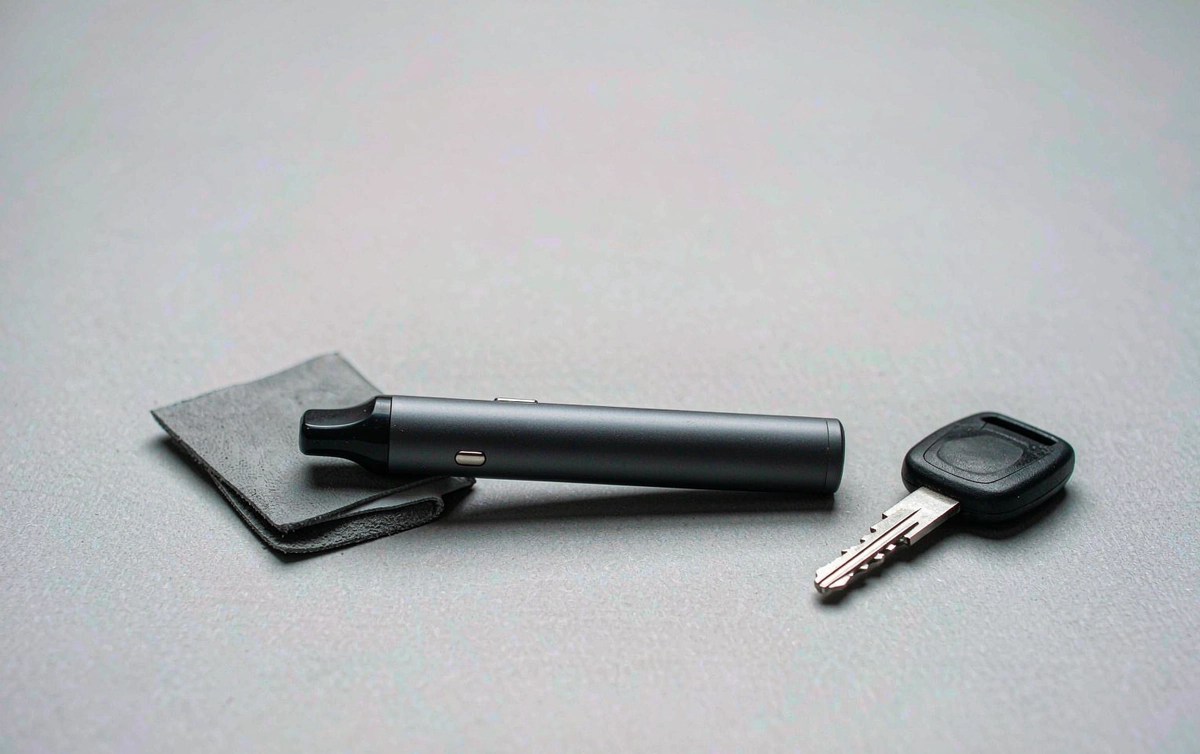
Is it legal to vape while driving in the US?
There is no federal statute that bans an adult from smoking or vaping while driving a private vehicle. That surprises people who assume a national rule exists. The CDC STATE System Vehicles Fact Sheet tracks state-level statutory law on smoking in personal vehicles, and its data is current only to 30 June 2024. What it records is narrow: laws about smoking in cars when a child is present.
Read the CDC disclaimer before you use any state list. It covers state statutes only. It excludes state regulations, county and city ordinances, attorney-general opinions and relevant case law. A city or county can therefore be stricter than the state table suggests. That is why no honest article can tell you a given state is definitely fine.
On the CDC’s own table, Georgia shows no restriction for private vehicles. That detail matters here: a nationwide question answered with a single-state headline will always mislead most of the people asking it. The right frame is the federal baseline, then the state carve-outs, then local rules.
| Child age threshold | Jurisdictions with a personal-vehicle smoking law (CDC, data to 30 June 2024) |
|---|---|
| Under 8 | Vermont |
| Under 13 | Louisiana |
| Under 14 | Alabama, Arkansas |
| Under 15 | Utah, Virginia |
| Under 16 | Delaware, West Virginia |
| Under 18 | California, Illinois, Maine, Oregon |
| Territories | Guam (under 17), Northern Mariana Islands and Puerto Rico (under 18) |
That gives 12 states plus three territories. The CDC also notes that 28 states and some territories had at least one restriction across worksites, childcare settings or personal vehicles combined — a figure that is often misreported as “28 states ban smoking in cars”. It is not the same claim.
One more distinction: these statutes say smoking. Whether a state’s definition of smoking captures an electronic cigarette depends on that state’s own statutory wording. We are not going to guess a list. If you need a definitive answer for a specific state, read the statute or ask a local lawyer.
Why do so many answers confuse smoking with vaping?
Because the statutes were written for combustible tobacco and the blog posts were written for search engines. Most legal summaries paste the car-smoking rules onto vaping without checking the definition. GOV.UK is refreshingly blunt about it: on the page explaining the 2015 changes, the rules “don’t apply to e-cigarettes (vaping)”.
That single sentence is the most useful fact in this whole topic. In the UK the car rule is a smoke-free law, not a nicotine law. In the US the CDC table tracks smoking statutes, and whether e-cigarettes fall inside them is a question of statutory definition, not of common sense. Treating the two as interchangeable produces confident, wrong answers.
| Question | What the official source actually says | What you should not assume |
|---|---|---|
| Is there a US federal ban? | No statute banning an adult alone in a private car appears in the federal materials we checked | That a “US vaping while driving law” exists |
| Do 12 states ban vaping in cars? | 12 states have laws about smoking in cars with a child present, per CDC | That those statutes automatically cover e-cigarettes |
| Does the UK 2015 rule cover vaping? | GOV.UK states the rules do not apply to e-cigarettes | That “smoke-free car” means “vape-free car” |
| Does legal mean safe to do? | NHTSA defines distraction as any activity that diverts attention from driving | That a lawful act cannot support a careless-driving charge |
So asking only whether it is legal to vape while driving misses the second half of the risk. Lawfulness and prudence are separate tests, and a police officer assessing your driving is applying the second one.
What does the UK 2015 car-smoking rule actually cover?
Since 1 October 2015, in England and Wales, a private vehicle must be smoke-free when three conditions are met at once. The Smoke-free (Private Vehicles) Regulations 2015, regulation 2 states them: the vehicle is enclosed, more than one person is present, and someone present is under 18. Both the person smoking and the driver who fails to stop them commit an offence.
The GOV.UK guidance adds the practical edges. A 17-year-old alone in a car is not covered. A convertible with the roof fully down is not enclosed. Opening a window or a sunroof does not make the car open-air. A motorhome being used as living accommodation is treated differently. The fixed penalty commonly quoted is £50.
| Element | Official wording or guidance | Does vaping fall under it? |
|---|---|---|
| Vehicle | Enclosed private vehicle; more than one person present | The rule is about smoking, not vaping |
| Person | A person under the age of 18 present | GOV.UK explicitly excludes e-cigarettes |
| Enforcement | Smoker and driver who does not prevent it both liable; £50 fixed penalty | Not a vaping penalty |
| Driving conduct | Highway Code Rule 148 lists smoking among driving distractions | Rule 148 does not name vaping |
Rule 148 deserves a careful read. Its “avoid distractions” list puts smoking alongside loud music, eating and drinking, and adjusting the stereo. It cites the Road Traffic Act 1988 sections 2 and 3. The MUST NOT wording applies to smoke-free public transport, work vehicles and vehicles carrying children under 18. The text does not name vaping, so treat it as general driving advice rather than a vaping statute.
In other words, a legal to vape answer for the UK is still conditional on conduct. The car-smoking law does not prohibit the device, but a distracted-driving standard can be applied to what you did with it. Our US and international vape law overview separates those two layers for other markets as well.
Can distraction laws still make legal to vape while driving a bad idea?
Yes, and this is the part that legal-summary articles usually omit. NHTSA’s definition is deliberately broad: “Distracted driving is any activity that diverts attention from driving”, including eating, drinking, talking to passengers and fiddling with the stereo. It adds that any non-driving activity is a potential distraction. Reaching for a device, refilling it or looking down to check a screen fits that description.
The scale is not trivial. NHTSA reports 3,208 people killed in crashes involving distracted drivers in 2024, and 315,167 people injured. Those figures cover all distraction, not vaping, and we are not going to imply otherwise. They explain why the legal question is a poor proxy for the safety question.
NHTSA is also explicit about where the law comes from: “Your state legislature and governor make the laws regarding distracted driving.” So the enforcement answer is local. A general careless-driving or due-care provision can be invoked without any statute that names e-cigarettes, which is exactly why a clean “legal” verdict is never the whole story.
Is it legal to vape in the car with children present?
This is where the state table becomes relevant and where the smoking-versus-vaping distinction matters most. In the 12 CDC-listed states, a law restricts smoking in a private vehicle when a child below that state’s age threshold is present. Whether an e-cigarette counts depends on how that statute defines smoking. Practical answer: assume the stricter reading until you have checked the wording.
Two limits apply even then. First, the CDC table is state statutes only, so a city or county ordinance may go further. Second, the table is dated 30 June 2024, and legislatures amend vehicle and smoke-free laws. Verify the current text before relying on any list, including this one.
In the UK the answer is the opposite kind of surprising: the 2015 smoke-free rule does not apply to e-cigarettes at all, so vaping with a child in the car is not caught by that regulation. It can still be raised as a distraction issue. For the narrower question of passengers and second-hand exposure, see vaping or smoking with kids in the car.
What about state pages like Georgia and Wisconsin?
State-specific pages are useful for state-specific facts, and useless as the headline for a nationwide question. Georgia appears on the CDC table with no personal-vehicle restriction, which makes it a particularly odd state to pin a general answer on. Wisconsin has its own detail worth reading separately if that is your jurisdiction.
Search data shows the mismatch clearly. Alongside “is it illegal to vape and drive” and “is it legal to vape while driving”, the same page also attracts queries about local vape shops and Georgia counties. Those are different intents. A general explainer should not be rewritten to chase a shop query; a state-specific driving-law page can handle the local detail instead.
The same boundary applies to impairment. Cannabis, alcohol and DUI thresholds are a separate legal topic with separate statutes, covered on our driving-high explainer. Do not fold those rules into a nicotine question.
Which common claims about vaping and driving do not hold up?
Five claims recur in search results, and each one collapses as soon as you read the primary source. This table is the fastest way to check anything you have been told.
| Common claim | What the official source says | Verdict |
|---|---|---|
| “12 US states ban vaping in cars” | CDC lists 12 states with laws on smoking in cars with a child present | Misleading |
| “UK law bans vaping with under-18s in the car” | GOV.UK: the rules do not apply to e-cigarettes | Wrong |
| “There is a federal US ban on vaping and driving” | No such federal statute; NHTSA points to state legislatures for distraction law | Wrong |
| “Opening a window makes a UK car legal to smoke in” | GOV.UK guidance says an open window or sunroof does not stop the car being enclosed | Wrong |
| “If it is legal to vape while driving, it is safe” | NHTSA: any activity that diverts attention is a potential distraction | Wrong |
How should a business answer customers asking if it is legal to vape while driving?
Do not issue a legal verdict in a product FAQ. Give the customer the official source, the date of the data, and the jurisdiction it covers. A defensible answer reads: “We cannot give legal advice; check the current state statute and any local ordinance.” That is slower than a yes, but it will not embarrass you when a rule changes.
Split the answer by market. A UK FAQ should quote the 2015 regulations and say plainly that e-cigarettes are excluded. A US FAQ should point to the CDC table, note its 30 June 2024 cut-off, and remind readers that city ordinances can be stricter. Keep a dated changelog so a support agent can see when the wording was last checked.
The wider compliance habit transfers. Our FDA authorization explainer shows why “authorized” is not “approved”, and the 2026 Austria rules show how quickly a national framework can move. The same discipline applies when you write a manufacturer checklist, verify a device is not a counterfeit, or explain what a pod system is.
So, is it legal to vape while driving? For an adult alone in a private car in most US states and in the UK, yes — with the child-passenger carve-outs, local ordinances and distraction standards above. The more useful question is whether you can do it without taking your attention off the road. If the honest answer is no, pull over.
This article is general information, not legal advice. It draws on CDC, GOV.UK, legislation.gov.uk and NHTSA sources current at the time of writing; statutes, regulations and local ordinances change. Check the official text for your jurisdiction before relying on any statement here, and never allow a device to distract you while driving.