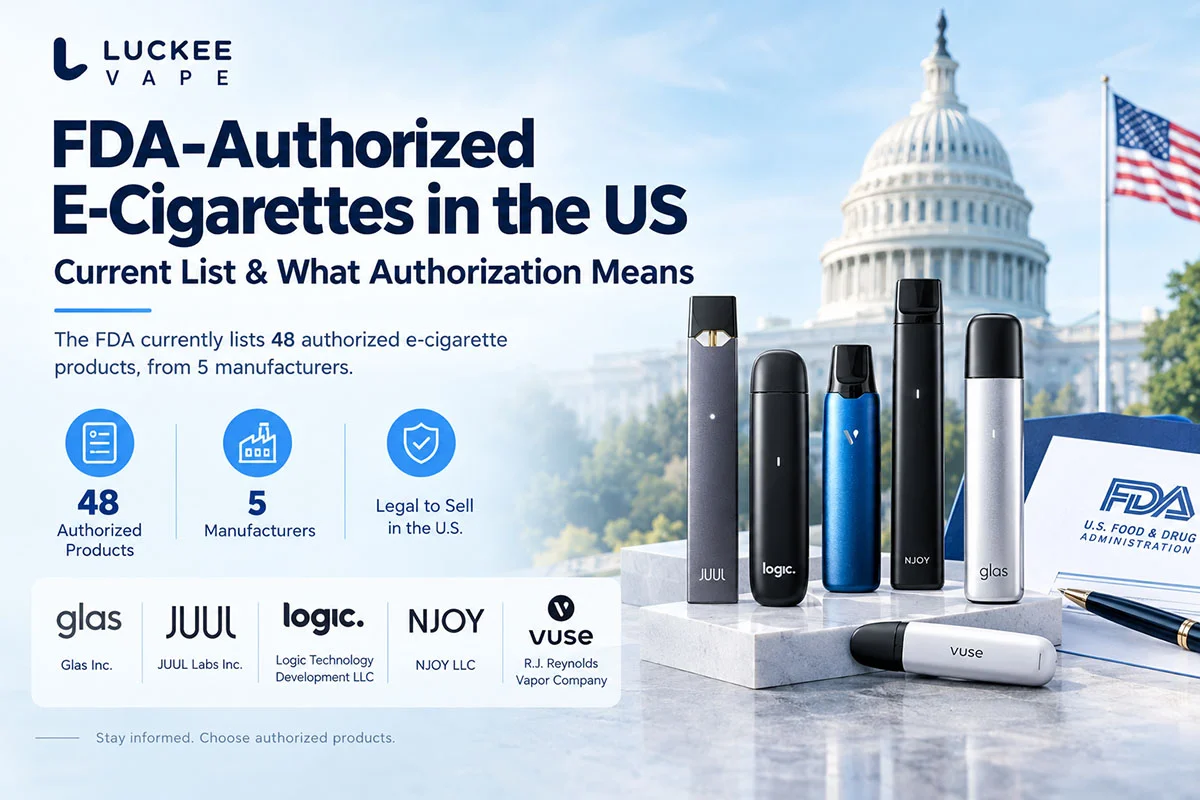
As of August 28, 2026, the FDA lists 48 authorized e-cigarette products, made by five manufacturers: Glas, JUUL, Logic, NJOY and R.J. Reynolds (Vuse). Those 48 are the only e-cigarettes the agency says may be lawfully sold in the United States.
One correction before the list. Strictly speaking, no vape is “FDA-approved.” The FDA authorizes specific products for marketing. That distinction is the reason every list you find online disagrees with the next one — and why how the FDA regulates vapes matters as much as the list itself.
How Many Vapes Are FDA-Approved in 2026?
The FDA currently lists 48 authorized e-cigarette products. That is the number on the agency’s own authorized-products page, whose content is marked current as of August 28, 2026.
The 48 break down by manufacturer like this:
| Manufacturer | Authorized product records | Brand |
|---|---|---|
| Glas Inc. | 6 | Glas G2 |
| JUUL Labs Inc. | 8 | JUUL, JUUL2 |
| Logic Technology Development LLC | 8 | Logic Pro / Power / Vapeleaf |
| NJOY LLC | 10 | NJOY ACE, NJOY DAILY |
| R.J. Reynolds Vapor Company | 16 | Vuse Alto / Solo / Vibe / Ciro |
| Total | 48 | — |
48 records is not 48 different vapes. The FDA counts each device, pod, cartridge, flavour and nicotine strength as its own authorized product. Six of the 48 are simply the Vuse Alto pods across three flavours and three strengths. Counted as complete systems, the list covers roughly ten named devices — and a few of those, such as Vuse Ciro, may no longer be widely sold.
Why you keep seeing other numbers. You will find pages claiming 23, 41 or 45 authorized vapes. Each was correct on the day it was written, and none has been updated since:
| Date | What changed | Running total |
|---|---|---|
| October 12, 2021 | Vuse Solo — the first e-cigarette ever authorized | 3 |
| March–May 2022 | Vuse Vibe and Ciro; NJOY Ace; Logic Vapeleaf, Pro and Power | 23 |
| June 2024 | NJOY DAILY and ACE menthol pods — the first menthol authorizations | 27 |
| July 18, 2024 | Vuse Alto device and six tobacco-flavoured pods | 34 |
| July 17, 2025 | JUUL device and four JUULpods | 39 |
| March 2026 | Glas G2 device and Blonde Tobacco pod — the first age-gated device | 41 |
| May 5, 2026 | Four Glas G2 pods, including the first two non-tobacco, non-menthol flavours | 45 |
| August 28, 2026 | JUUL2 device plus tobacco and menthol pods | 48 |
So the widely copied “23 FDA-approved vapes” figure dates from 2022. If a page quotes a number without a date, treat the number as a snapshot, not a fact.
The Complete FDA-Authorized Vape List (2026)
Every product below appears on the FDA’s authorized e-cigarette page as of August 28, 2026. Names are given as the FDA lists them, because that is the only form that counts for compliance — “a Vuse Alto pod” is not an authorized product; “Vuse Alto Pod Golden Tobacco 5%” is.
Glas Inc. — 6 products (Glas G2 system)
| Product as listed by FDA | What it is |
|---|---|
| Glas G2 DEVICE | Rechargeable device with age-verification access control |
| BLONDE TOBACCO 50 MG/ML Pod | Tobacco-flavoured pod |
| GOLD 50 MG/ML Pod | Mango-flavoured pod — one of the first two non-tobacco, non-menthol flavours ever authorized |
| SAPPHIRE 50 MG/ML Pod | Blueberry-flavoured pod |
| FRESH MENTHOL 50 MG/ML Pod | Menthol pod |
| CLASSIC MENTHOL 50 MG/ML Pod | Menthol pod |
JUUL Labs Inc. — 8 products
| Product as listed by FDA | What it is |
|---|---|
| JUUL Device | Original device |
| JUULpods Menthol 3.0% | Menthol pod |
| JUULpods Menthol 5.0% | Menthol pod |
| JUULpods Virginia Tobacco 3.0% | Tobacco pod |
| JUULpods Virginia Tobacco 5.0% | Tobacco pod |
| JUUL2 Device | Next-generation device with app-based age gating |
| JUUL2 Virginia Tobacco 2-pack, 18 mg/mL | Tobacco pods, 1.6% nicotine |
| Polar Menthol JUUL2 pod | Menthol pod |
Logic Technology Development LLC — 8 products
| Product as listed by FDA | What it is |
|---|---|
| Logic Regular Cartridge/Capsule Package | Tobacco-flavoured cartridge |
| Logic Pro Capsule Tank System (1) | Device and capsule system |
| Logic Pro Capsule Tank System (2) | Second authorized configuration |
| Logic Vapeleaf Cartridge/Capsule Package | Tobacco-capsule cartridge |
| Logic Vapeleaf Tobacco Vapor System | Heated tobacco-capsule system |
| Logic Power Tobacco e-Liquid Package | Tobacco e-liquid |
| Logic Pro Tobacco e-Liquid Package | Tobacco e-liquid |
| Logic Power Rechargeable Kit | Rechargeable device kit |
NJOY LLC — 10 products
| Product as listed by FDA | What it is |
|---|---|
| NJOY DAILY Rich Tobacco 4.5% | Closed disposable |
| NJOY DAILY Menthol 4.5% | Closed disposable |
| NJOY DAILY EXTRA Rich Tobacco 6% | Closed disposable |
| NJOY DAILY EXTRA Menthol 6% | Closed disposable |
| NJOY ACE Device | Rechargeable pod device |
| NJOY ACE POD Classic Tobacco 2.4% | Tobacco pod |
| NJOY ACE POD Classic Tobacco 5% | Tobacco pod |
| NJOY ACE POD Rich Tobacco 5% | Tobacco pod |
| NJOY ACE POD Menthol 2.4% | Menthol pod |
| NJOY ACE POD Menthol 5% | Menthol pod |
R.J. Reynolds Vapor Company — 16 products (Vuse)
| Product as listed by FDA | What it is |
|---|---|
| Vuse Alto Power Unit | Device |
| Vuse Alto Pod Golden Tobacco 5% / 2.4% / 1.8% | Tobacco pods, three strengths |
| Vuse Alto Pod Rich Tobacco 5% / 2.4% / 1.8% | Tobacco pods, three strengths |
| Vuse Solo Power Unit | Device |
| Vuse Replacement Cartridge Original 4.8% G1 | Tobacco cartridge, first version |
| Vuse Replacement Cartridge Original 4.8% G2 | Tobacco cartridge, second version |
| Vuse Vibe Power Unit (1) / (2) | Device, two authorized configurations |
| Vuse Vibe Tank Original 3.0% | Tobacco tank |
| Vuse Ciro Power Unit (1) / (2) | Device, two authorized configurations |
| Vuse Ciro Cartridge Original 1.5% | Tobacco cartridge |
Two notes that trip people up. Authorized does not mean on the shelf — Vuse Ciro’s marketing orders remain valid even though the product can be hard to find. And an authorized brand does not mean an authorized product: Vuse Alto’s menthol and mixed-berry pods were refused authorization and remain unlawful to sell.
“FDA-Approved” vs “FDA-Authorized”: What’s the Actual Difference?
An FDA authorization is a marketing order issued under the premarket tobacco product application (PMTA) pathway, 21 U.S.C. § 387j. The FDA grants it when it concludes that allowing the product on the market is “appropriate for the protection of the public health,” weighing the benefit to adults who switch away from cigarettes against the risk of youth uptake.
That is not the same as approval, and the FDA says so itself on the page where it publishes the list:
While these products are authorized to be sold in the United States, it does not mean these products are safe, nor are they “FDA approved.” All tobacco products are harmful and potentially addictive.
Three practical consequences:
- Authorization is product-specific. It attaches to a named product, flavour and nicotine strength. It never covers a brand as a whole.
- A pending application is not an authorization. Most vapes sold in the US sit in that middle ground: their PMTAs were filed before the September 9, 2020 deadline and are still under review, or they were refused. Neither state is “authorized.”
- Reduced-risk claims are a separate pathway. A modified risk tobacco product (MRTP) order has a different standard. A marketing order does not imply one.
So the phrase everyone searches — “FDA approved vapes” — describes something that, in the FDA’s own words, does not exist. What exists is a short list of 48 authorized products.
Are Any Flavored Vapes FDA-Approved?
Yes — two of them, since May 5, 2026. For the first time, the FDA authorized e-cigarette flavours outside tobacco and menthol:
- Glas GOLD (mango), 50 mg/mL
- Glas SAPPHIRE (blueberry), 50 mg/mL
Both are G2 pods that work only with the Glas G2 device. Before this decision, every authorized product was tobacco- or menthol-flavoured; NJOY’s menthol pods, authorized in June 2024, had been the first exception in that direction. Our own write-up of the first fruit-flavoured authorizations covers the announcement and industry reaction in more detail.
What made the difference was age-gating, not flavour science. The Glas G2 requires the user to verify age and identity with a government-issued ID, pair the device to that verified phone over Bluetooth, and keep the phone nearby while vaping — the app runs periodic biometric checks, and the device will not work away from the paired phone. The FDA treated that device-level access restriction as effective youth-risk mitigation, and framed it explicitly as “an additional way” for non-tobacco-flavoured products to meet the standard when youth risk is controlled and adult benefit outweighs it.
That makes the rule for 2026 simple: a flavoured vape is authorized only if you can name the exact product, and today that name is Glas Gold or Glas Sapphire. Every other fruit, dessert or candy flavour sold by any other brand remains unauthorized — a position the courts have backed, including in the Supreme Court’s 2025 decision in FDA v. Wages and White Lion Investments.
Are Any Disposable Vapes FDA-Approved?
Yes, but only four records, all from one brand: NJOY DAILY and NJOY DAILY EXTRA — Rich Tobacco 4.5%, Menthol 4.5%, EXTRA Rich Tobacco 6% and EXTRA Menthol 6%. They are closed, non-refillable and non-rechargeable, which is what makes them disposables in the FDA’s sense. Like all closed-system disposable vapes, they ship with a fixed flavour and strength.
Everything else on a US shelf is almost certainly not on the list. Puff Bar, Elf Bar, Lost Mary, Geek Bar and the high-puff-count disposables that dominate the market hold no marketing authorization; the FDA has issued marketing denial orders to many of them, and enforcement against unauthorized disposables is a stated priority.
Do US States Have Their Own Approved-Vape Lists?
Yes, and this is the part most FDA lists leave out. Federal authorization is not the only list that decides whether a product can legally be sold. Several states run their own directories, and FDA authorization is usually the entry ticket.
Wisconsin is the clearest example. Under 2023 Wisconsin Act 73 and Wis. Stat. § 995.15, manufacturers must certify to the Wisconsin Department of Revenue that their device has been authorized by the FDA — or was already on the US market as of August 8, 2016 with a PMTA filed by September 9, 2020 that is still under review. The DOR then publishes an Electronic Vaping Device Directory. A device that is not on that directory cannot be sold, offered for sale, or possessed for sale in Wisconsin. The rule has applied to nicotine devices since September 1, 2025, with a forfeiture of $1,000 per device per day on manufacturers and retailers, plus seizure and destruction of the stock and exposure under the state’s unfair and deceptive trade practices law. Non-nicotine hemp devices received an extension to July 1, 2026.
Two details worth knowing. The state directory is broader than the FDA’s 48 — it also covers components, accessories and e-liquids, and runs to several hundred entries. And it is under litigation: in the Wisconsin vape law and the lawsuit it triggered, the Seventh Circuit upheld the statute in April 2026, rejecting the argument that federal tobacco law preempts a state’s authority to regulate sales.
Wisconsin is not alone in tying shelf access to the federal list. Alabama’s FDA-approved-only rule requires vapour products sold in the state to be FDA-authorized or manufactured in Alabama, and more states have introduced similar directory or approved-product bills.
The takeaway for anyone selling into the US: the FDA list is the floor, not the ceiling. A product can be federally authorized and still be unsellable in a given state if it was never certified to that state’s directory.
How to Check Whether a Specific Vape Is Authorized
Four steps, in this order:
- Open the FDA’s authorized e-cigarette page (fda.gov/authorizedecigs). The FDA says it updates this page on the day of an authorization — it is the first place new products appear.
- Search the FDA’s Searchable Tobacco Products Database. This is the most comprehensive listing of products that may legally be sold, updated the day after an authorization.
- Match the exact name, flavour and nicotine strength. This is where most mistakes happen. A brand’s tobacco pods can be authorized while its menthol pods are not, and the difference is not obvious on the packaging.
- Check the state directory if you sell or ship into a state that maintains one — Wisconsin’s sits on the DOR site.
Two claims that mean nothing on their own: “FDA registered” and “FDA compliant.” Registration is not authorization, and there is no FDA certificate that makes a vape legal. If a supplier offers you “FDA-approved” stock, the burden is on them to show you the exact product entry in the FDA database — our guide to spotting fake FDA listings covers what those documents should look like.
What Happens If You Sell an Unauthorized Vape in the US?
An unauthorized e-cigarette is, in the FDA’s terms, an adulterated or misbranded tobacco product, and the consequences escalate:
- Seizure of the product, and an injunction against continued sales
- Civil money penalties, with retailers now a stated enforcement priority rather than only manufacturers and importers
- Import refusal — the FDA can place a manufacturer or shipper on import alert, which stops stock at the border rather than at the shelf
- State-level exposure on top of the federal one, including the Wisconsin forfeiture described above
The FDA’s 2026 ENDS enforcement guidance narrowed its stated priorities rather than widening them, which is worth reading in full if you import: a low enforcement rate is not the same thing as legal status.
What This Means for Vape Brands and Manufacturers
Three lessons for anyone building a vape brand in 2026:
1. Authorization is now a shelf-access question, not just a legal one. Between federal enforcement and state directories, an unauthorized product increasingly has nowhere to be sold — including in states that used to be permissive.
2. Age-gating opened a real door for flavours. Glas is a small, independent manufacturer with no tobacco-company ownership, and it won the first non-tobacco, non-menthol authorizations by building device-level access restriction rather than by arguing flavour science. That is the template the FDA has now signposted.
3. Authorization does not travel between markets. A US marketing order means nothing in the EU, the UK or the Gulf, where TPD/TRPR, MHRA notification and GSO/SASO conformity each apply separately.
Our own position, plainly: LuckeeVape’s products are not FDA-authorized for the US market, and we do not claim otherwise. Our compliance work targets the markets where we sell — EU TPD and UK MHRA requirements, and regional standards in the Middle East. If you are sourcing for the US, start from the FDA list above and confirm your supplier can name the exact authorized product; for everything else, see our notes on sourcing compliant disposables for the US.
Frequently Asked Questions
Which vape brands are FDA-authorized in 2026?
Five: Glas, JUUL Labs, Logic Technology Development, NJOY, and R.J. Reynolds Vapor Company (Vuse). Together they account for all 48 authorized products.
How many vapes are FDA-approved?
The FDA currently lists 48 authorized e-cigarette products, as of August 28, 2026. The number counts devices, pods and cartridges separately, so it represents roughly ten complete vape systems rather than 48 different devices.
Are any flavored vapes FDA-approved?
Yes — two. Since May 5, 2026 the Glas G2 pods named Gold (mango) and Sapphire (blueberry), both 50 mg/mL, are authorized. They are the only non-tobacco, non-menthol flavours ever authorized.
Are disposable vapes FDA-approved?
Only NJOY DAILY and NJOY DAILY EXTRA, in tobacco and menthol. No other disposable vape brand sold in the US holds marketing authorization.
Is JUUL FDA-approved?
Partly. The FDA authorized the JUUL device and four JUULpods — menthol and Virginia Tobacco, at 3.0% and 5.0% — in July 2025, and added the JUUL2 device and two JUUL2 pods in August 2026. JUUL’s older flavours, such as mango, fruit and crème, are not authorized.
Does FDA authorization mean a vape is safe?
No. In the FDA’s own wording, authorization does not mean the products are safe, and all tobacco products are harmful and potentially addictive. Authorization means the agency permits marketing under a public health standard.
Can I sell a vape that is not FDA-authorized?
No. Unauthorized e-cigarettes may not be legally sold in the US, and selling them can lead to seizure, injunctions, civil penalties and import refusal. In states such as Wisconsin, listing on the state directory is a separate requirement with its own per-day forfeiture.
Where can I find the official FDA-authorized vape list?
On the FDA’s authorized e-cigarette page, fda.gov/authorizedecigs, and in the FDA’s Searchable Tobacco Products Database. Third-party lists go stale quickly; this page is reviewed against the FDA’s own records.
So, Which Vapes Are FDA-Approved?
There is no such thing as an FDA-approved vape — but there is a definite, checkable answer to the question people are actually asking. As of August 28, 2026, the FDA has authorized 48 e-cigarette products from Glas, JUUL, Logic, NJOY and Vuse, and those 48 are the only ones that may be lawfully sold in the United States. Two of them, Glas Gold and Sapphire, are the first flavoured products on the list; four are the only authorized disposables. Everything else on a US shelf is there without authorization, and in a growing number of states it cannot be sold at all.
Last reviewed: September 2026. Sources: FDA — E-Cigarettes, Vapes and Other ENDS Authorized by FDA (content current as of 08/28/2026); FDA — Tobacco Products Marketing Orders; Wisconsin Department of Revenue Pub 304 and the Electronic Vaping Device Directory; 2023 Wisconsin Act 73; WiscoFAST v. Casey, 7th Cir. (April 21, 2026). This article is general regulatory information, not legal advice.