


The Short Answer
The number printed on a coil — 0.6Ω, 0.8Ω, 1.2Ω — is its resistance. Lower resistance lets more current flow from the battery at the same voltage, so the coil heats faster, makes more vapour, and drains your battery faster. Higher resistance does the opposite: a cooler, tighter, more economical puff.
Anything below 1.0Ω counts as sub-ohm; 1.0Ω and above is a standard coil. Neither is “better” — they are built for two different ways of vaping, and most rechargeable pod devices let you switch between them simply by changing the pod.
If you remember one line, remember this: halve the resistance and you roughly double the power the coil wants. That one relationship explains almost every coil question — which wattage to use, why one coil tastes warm and another feels flat, and why your 20mg salt liquid that feels perfect at 1.2Ω becomes unbearable at 0.6Ω.
What Does the Ohm (Ω) Number Actually Mean?
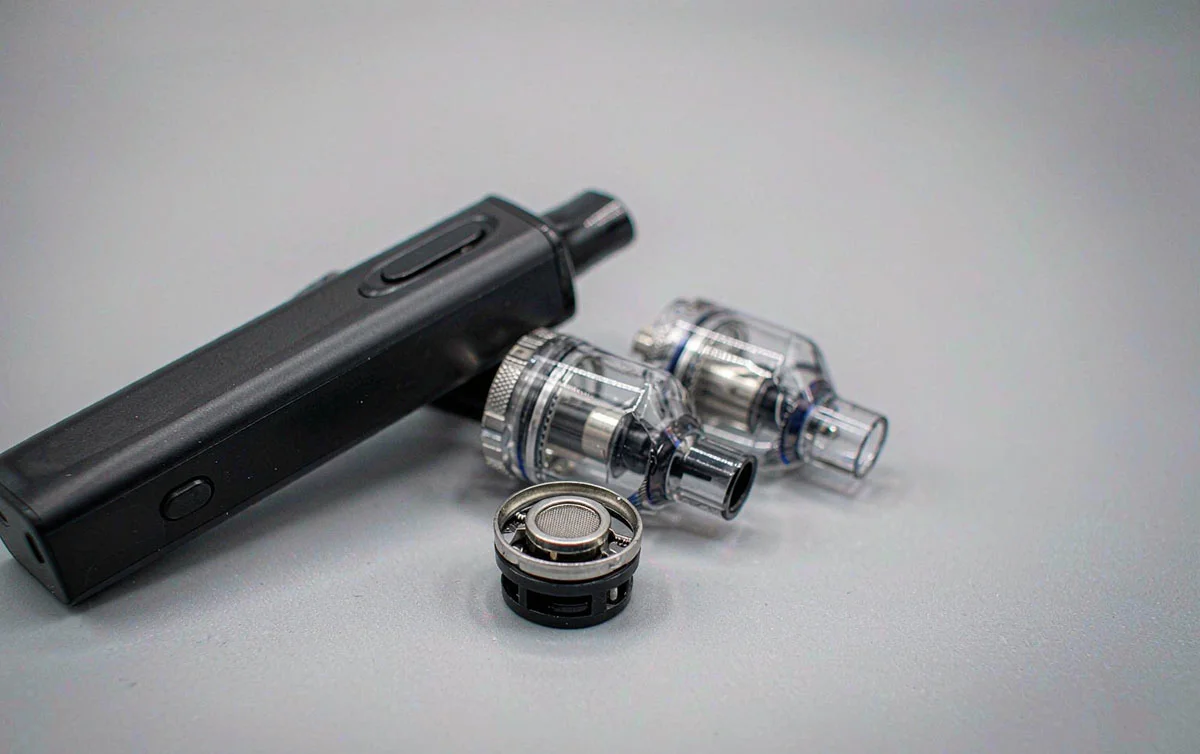
Ohms measure electrical resistance — how much a coil pushes back against the current coming from the battery. In your vape, the resistance lives in the coil: the small heating element that turns e-liquid into vapour. If you want the wider picture first, our explainer on pod systems explained covers how the whole device fits together.
The physics is simpler than it looks. Ohm’s Law says current equals voltage divided by resistance. Keep the voltage steady and a lower-resistance coil pulls more current; a higher-resistance coil pulls less. More current means more heat, and more heat means more e-liquid vapourised every second.
What physically sets that resistance is the coil itself. A thicker or shorter wire has less resistance; a thinner or longer wire has more. That is why one coil can sit at 0.6Ω and another at 1.2Ω while both do the same basic job — the number is a design outcome, not an arbitrary label.
So resistance is not a quality score. It is a dial that decides how hard your device works.
What Actually Changes Between a Low and a High Resistance Coil?
Four things move together, and they all follow from that one relationship:
- Heat and vapour. A low-resistance coil runs hotter and produces more vapour per puff. A high-resistance coil runs cooler and produces less.
- Battery life. Low resistance pulls more current, so the battery drains faster and needs charging more often. Higher resistance sips power and stretches a charge.
- E-liquid use. Sub-ohm setups can go through two to four times more e-liquid than a mouth-to-lung coil, simply because they vaporise more per puff.
- Draw style. Below 1.0Ω is built for a loose, direct-to-lung (DTL) inhale. At 1.0Ω and above you get a tight mouth-to-lung (MTL) draw, closer to how you smoke a cigarette — the same airflow trade-off we cover in why airflow and coils matter.
One more variable sits on top of all this. Mesh coils — the flat, perforated strips now standard in most pods — spread the same heat across a larger surface, so they vaporise more evenly than a traditional round wire. Two coils can share a resistance and still feel different because of it. That is why the printed wattage range, not the ohm figure alone, is the number to trust.
0.6Ω vs 0.8Ω vs 1.0Ω vs 1.2Ω: The Table
These are the resistances you will actually meet on pod and kit coils. Treat them as typical ranges — the wattage printed on the coil itself always overrides any table.
| Resistance | Typical wattage | Draw style | Feel | Best e-liquid |
|---|---|---|---|---|
| 1.2Ω | About 8–15W | Tight MTL | Coolest, least vapour, clearest throat hit | 20mg nic salt, 50/50 |
| 1.0Ω | About 10–15W | Firm MTL | The MTL ceiling, slightly warmer than 1.2Ω | Nic salt, 50/50 |
| 0.8Ω | About 12–20W | Airy MTL / restricted lung | The all-rounder — fuller flavour, moderate vapour | 10–20mg salt, 50/50 |
| 0.6Ω | About 15–25W | Restricted to open lung | Warmest, biggest clouds, strongest flavour | Lower strength — around 10mg salt or low freebase |
Two rules sit behind the whole table. First, resistance and wattage move in opposite directions — lower ohms want more watts. Second, more power pulls more liquid per second, which is why a sub-ohm coil needs a wider wicking channel and a thicker liquid to keep up.
What’s the Difference Between 0.6 and 0.8 Ohm?
This is the comparison most people actually search for, so here it is side by side.
| 0.6Ω | 0.8Ω | |
|---|---|---|
| Wattage | 15–25W (higher) | 12–20W (lower) |
| Draw | Restricted to open lung | Airy MTL / restricted lung |
| Warmth | Warmer | Slightly cooler |
| Vapour | Larger | Moderate |
| Flavour | Stronger and more layered | Full but balanced |
| Battery | Drains faster | Lasts longer |
| E-liquid | Needs lower strength | Handles up to 20mg salt |
| Best for | Chasing clouds and an open draw | Most people — the safe default |
In one sentence: 0.6Ω gives you a bigger, warmer, more flavour-packed puff at the cost of battery and e-liquid; 0.8Ω trades a little of that for longer battery life and a more forgiving draw.
If you are unsure, 0.8Ω is the sensible starting point — it is the resistance most modern pod kits ship with, and it sits between a tight pod draw and a proper lung hit.
Which Ohm Coil Should You Use?
Ignore the numbers for a second and start with how you like to vape. The coil follows from that.
- If you want a cigarette-like draw, stay at 1.0Ω or above and keep the wattage low. This is where most people switching from smoking start.
- If you want something airier for all-day use, 0.8Ω is the middle ground — enough warmth for flavour, not so much that it drinks your battery.
- If you want big, warm clouds, drop to 0.6Ω and open the airflow.
- If you are not sure, start at 0.8Ω, then move one step up or down based on what you dislike. Too warm and harsh? Go higher. Too cool and flat? Go lower.
The mistake that makes a “bad coil” is almost never a bad coil. It is a mismatch — the wrong resistance run at the wrong wattage, or paired with the wrong liquid.
The other constraint is your device. Every regulated vape has a minimum resistance it will fire, usually printed in the manual, and a coil below that simply will not work. Check before you buy: a pod built around 1.2Ω MTL coils will not run a 0.6Ω coil, and a high-power sub-ohm tank is wasted on a 1.0Ω coil.
Matching Resistance to Your E-Liquid and Nicotine
Resistance and e-liquid have to agree, or you get dry hits, leaks or a throat that feels like sandpaper. (If you want the detail on that last one, see how throat hit works.)
- High-PG liquid (50/50) is thin and wicks quickly through narrow ports — it suits higher-resistance MTL coils. Put 70/30 VG in a 1.2Ω coil and it wicks too slowly, dries out and burns.
- High-VG liquid (70/30 and up) is thick and needs wide wicking ports and higher power — it suits sub-ohm coils. Put 50/50 in a 0.15Ω coil at 80W and it floods, leaks and spits.
- Nicotine strength must fall as resistance falls. A sub-ohm coil vapourises far more liquid per puff, so it delivers more nicotine from the same bottle. 3–6mg freebase suits a 0.2–0.4Ω build, while a 20mg salt that feels right at 1.2Ω is genuinely unpleasant at 0.6Ω. That mismatch is behind most “vaping made me dizzy” complaints.
The simplest mental model: think of resistance and nicotine as a seesaw. As the coil gets hotter and more powerful, the nicotine strength has to come down to keep each puff comfortable. Get that balance right and the same liquid can feel right across several devices — get it wrong and either it burns your throat or it tastes of nothing at all.
Is Sub-Ohm Safe?
Sub-ohm vaping is not inherently risky — but it pulls more current, so the battery has to keep up.
- Never fire a coil below what your device supports. The minimum resistance in your manual is a current limit, not a suggestion.
- Never pair very low resistance with high-strength salt nicotine. A 50mg liquid through a 0.15Ω coil is a genuinely unpleasant dose.
- Regulated devices protect you; mechanical mods do not. Regulated chips cut power if a build is unsafe. Mech mods have no such safety net — which is exactly why they are not a beginner’s device.
- Check the reading before you fire. A resistance that jumps around or sits far from the printed value means a loose connection or a faulty coil. Fix it, do not vape through it — and if the device itself is running hot, that is usually a separate warning sign, covered in why your vape gets hot.
One more thing worth knowing: if a coil is already scorched, no wattage setting will rescue it. A burnt coil is a physical problem, and the fix is a fresh coil — we cover that in full in why your vape tastes burnt.
None of this makes sub-ohm vaping risky in itself — it is the setup most modern vapers use every day. The point is simply that lower resistance asks more of your device, so a battery rated for that current matters as much as the coil. If you are unsure what your device supports, stay with the coils the manufacturer sells for it; they are matched to it by design.
Frequently Asked Questions
What does 0.6Ω mean on a coil?
0.6Ω means the coil has a resistance of 0.6 ohms — a low-resistance, or sub-ohm, coil. It pulls more current, runs warmer and produces more vapour than a 0.8Ω or 1.2Ω coil, and it wants roughly 15–25W. It suits an open lung draw and lower-strength liquid.
What does 1.2Ω mean on a coil?
1.2Ω is a higher-resistance coil. It restricts current, so it runs cooler, produces less vapour and is easier on the battery — typically around 8–15W. It gives a tight, cigarette-like mouth-to-lung draw and pairs well with 20mg nicotine salt.
Does lower resistance use more battery?
Yes. A lower-resistance coil draws more current from the battery, so it drains faster and needs charging more often. Higher-resistance coils sip power and last longer between charges.
Is a 0.6 or 0.8 coil better for flavour?
Both give strong flavour, but they deliver it differently. The 0.6Ω runs warmer and pushes flavour harder; the 0.8Ω is slightly cooler and more balanced. If you vape lower-strength liquid and want the fullest flavour, 0.6Ω. If you want flavour without draining your battery, 0.8Ω.
Can I use a 0.6Ω coil with 20mg nicotine salt?
You can, but you probably should not want to. A sub-ohm coil delivers far more vapour — and therefore far more nicotine — per puff than a 1.2Ω MTL coil. A 20mg salt that feels right at 1.2Ω is usually too harsh at 0.6Ω. Drop to around 10mg salt or a low-strength freebase instead.
Does coil resistance affect how long a coil lasts?
Indirectly. Lower resistance runs hotter, and more heat plus more e-liquid throughput wears the wick and coil out faster. Gentler, higher-resistance coils tend to last longer, especially with less sweet, thinner liquid.
The Bottom Line
Coil resistance is one number that quietly decides four other things: wattage, draw, e-liquid and nicotine strength. Read it once and every other choice follows.
- Below 1.0Ω is sub-ohm: warmer, more vapour, more battery drain, lower nicotine.
- 1.0Ω and above is mouth-to-lung: cooler, tighter, more economical, higher nicotine.
- 0.8Ω is the safe default; go down for clouds, up for a cigarette feel.
- Whatever the label says, start at the bottom of the printed wattage range and work up until the flavour is full — then stop.
Once you know your resistance, matching the liquid and the wattage is easy. If you are still deciding what kit to build around, our guide to the best vape kits walks through the options by experience level, and if you want to understand the coil itself, it is worth reading what dual mesh coils actually do. Sourcing at scale, OEM and private-label production is how brands get matched coils to market.
This article is general information about coil hardware, not medical advice. Adults only. Nicotine is addictive; vaping is not risk-free and is not for non-smokers or under-18s. Always follow the wattage range printed on your coil and the minimum resistance specified by your device.