

Black Wave is black currant. Not a device, not a puff count, not a limited edition — it is the code name printed on the blackcurrant pod. Black Lite is something else again: a separate eight-flavour line, not a weaker version of the same juice.
That naming system is why so many people get the range wrong. Below is the full decoder — what is confirmed by the brand’s own retailers, what is still guesswork, and what a wholesale buyer has to check before committing to a lineup.
What does Black Wave actually taste like?
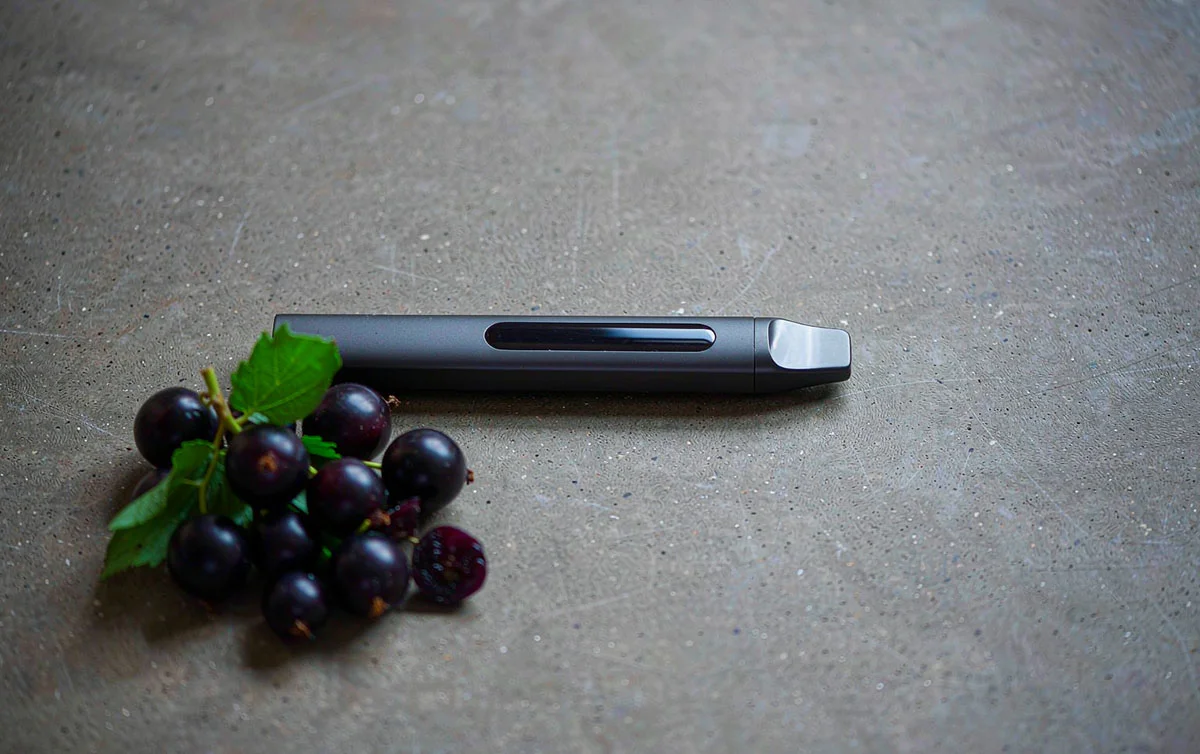
Black currant. Dark, tart, faintly sweet, usually finished with a cooling edge. If you have eaten a blackcurrant sweet, that is the reference point — not grape, not blueberry, and definitely not “black” anything.
The confusion is understandable, because Black also sells Trouble Purple, which is grape. Two dark-berry names, two very different liquids. Currant is sharper and more acidic on the finish; grape is rounder and more candy-like. If you are choosing between them, that is the whole decision.
There is a second layer of confusion worth clearing up. “Black Wave” does not promise a colour, a strength or a device tier — black is branding, wave is the code. Read it literally and you expect a black bar or a dark tobacco blend, and get a berry pod instead.
The mapping is not published by the brand. It comes from authorised Philippine retailers, who list the pod as “Black Wave (BLACKCURRANT)”, and from manufacturer flavour lists that print “Black Currant (Black Wave)”. Both agree. The BIR’s register of vapour products lists “BLACK ELITE 12000 BLACK WAVE” as a registered variant at 30 mg/mL.
That is the practical takeaway. In this range the code name is a label, the second word is the flavour, and the only reliable source for the pairing is a retailer who prints both.
What is Black Lite, and how is it different from Elite?
Black Lite 8000 is a separate registered product line with its own eight flavour names. It sits in the same 8,000-puff tier as Black Elite 8000, but the flavour vocabulary is different: only Cheer Blast and Ice Monkey appear on both lists.
The trap is the word “lite”. It does not mean lower nicotine. The Philippine Bureau of Internal Revenue registers Black Lite 8000 pods at the same 30 mg/mL as Black Elite. “Lite” refers to the product line, not the strength — which is exactly the kind of detail that gets lost when a retailer copies a listing.
The full Black flavour list, decoded
Sixteen names have a documented mapping. Every one pairs a brand-facing code name with the flavour inside:
| Code name | Actual flavour | Taste family |
|---|---|---|
| Black Wave | Black currant | Dark berry, tart |
| Trouble Purple | Grape | Dark fruit, candy |
| Red Pulp | Watermelon | Melon, sweet |
| Very Baguio | Strawberry | Red fruit |
| Blue Freeze | Blueberry | Berry, iced |
| Very More | Mixed berries | Berry blend |
| Cheer Blast | Lychee | Tropical |
| Pitch Perfect | Honey peach | Stone fruit |
| Ice Monkey / Yellow Monkey | Banana (iced) | Tropical, creamy |
| Sparkle Squeeze | Lemon cola | Soda, citrus |
| Rainbow Punch | Fruit punch (Kool-Aid style) | Mixed fruit, sweet |
| Sweet Forest | Green apple | Orchard fruit, sharp |
| Yellow Green | Lemon lime | Citrus |
| Bacteria Monster | Yakult (cultured milk) | Sour dairy |
| Jitter Mud | Cappuccino | Coffee, dessert |
| Beer Sparkle | Root beer | Soda, herbal |
| Fresh Menthol / Menthol | Mint | Cooling |
Read that table as a translation layer. It is what turns “Bacteria Monster” from an unreadable label into a one-line description a customer can act on — and it is the difference between a flavour list that sells and one that sits on the shelf.
The names nobody has decoded
The register lists more variants than any retailer explains. These appear on pods and invoices, but no published source maps them to a flavour:
| Code name | Line | Best available read |
|---|---|---|
| Cheer Blast | Black Lite 8000 | Lychee — confirmed on Elite |
| Ice Monkey | Black Lite 8000 | Banana ice — confirmed on Elite |
| Brick Kuchen | Black Lite 8000 | “Kuchen” is German for cake; likely a baked dessert |
| Bubble Blower | Black Lite 8000 | Probably bubblegum; unconfirmed |
| Squeeze Salt | Black Lite 8000 | Likely salted citrus; unconfirmed |
| Tobacco Blonde | Black Lite 8000 | Blonde (Virginia-style) tobacco |
| Very Monkey | Black Lite 8000 | Banana variant; unconfirmed |
| White Summer | Black Lite 8000 | No reliable read |
| Green Tokyo | Elite 12000 / 8000 | No reliable read |
| Yellow Summer | Elite 12000 | No reliable read |
| Round Melo | Elite 12000 | Name suggests melon; unconfirmed |
| Sticky Worms | Elite 12000 | Name suggests gummy sweets |
| Tangy Plump | Elite 12000 | Name suggests plum; unconfirmed |
| Belgium Delight | Elite 8000 | Likely chocolate or waffle |
| Blue Bake | Elite 8000 | Likely a baked blueberry profile |
| Purple Snow | Elite 8000 | Grape with cooling; unconfirmed |
The honest column here is the third one. If a supplier quotes you a flavour description for White Summer or Green Tokyo, ask which document it comes from — because there is no public mapping, and a confident answer with no source is a guess wearing a suit.
Why a vape brand uses code names at all
Three reasons, and none of them are mysterious:
- Descriptor exposure. Regulators increasingly treat flavour words as the enforcement hook. A pod labelled “Black Wave” carries no food or dessert claim on the face of the pack.
- Channel separation. The same liquid can ship under different names to different retail chains, so price comparisons across shops become harder.
- Shelf differentiation. When every bar in the case says Watermelon Ice, a name that requires decoding is a reason to pick it up.
This is a standard OEM/ODM convention rather than a Black quirk. Any private-label buyer choosing flavour names runs into the same three constraints — see our OEM manufacturing guide for how the naming step sits inside a build.
It also explains a resale problem that catches new distributors. When the same liquid ships under two names to two chains, a shop that stocks both ends up competing with itself — the customer picks whichever name sounds better, not whichever is fresher. Retailers who know the code names avoid stocking duplicate profiles and stop discounting against their own inventory.
Which Black lines are actually registered
The cleanest source is the Philippine tax register, not a shop page. As of 30 June 2026, the BIR lists these under importer JEY 888 Trading Corporation:
| Line | Registered variants | Registered strength | Notes |
|---|---|---|---|
| Black Elite 8000 | 17 | 30 mg/mL, 10 mL pod | Widest flavour spread |
| Black Elite 12000 | 15 | 30 mg/mL, 10 mL pod | Includes Sticky Worms, Tangy Plump |
| Black Lite 8000 | 8 | 30 mg/mL, 10 mL pod | Separate naming set |
| Black Pod Formula | 1 | 3%, 30 mL bottle | Refill format |
Retailers also sell a V1 15,000-puff and a V2 12,000-puff pod, both legitimate pods for the same battery family but absent from that register extract. Higher puff-count listings (25K, 35K, 50K, “Pro”) circulate online without a consistent published specification — treat them as unverified until a supplier shows you the device.
What the puff number is really telling you
8,000, 12,000 and 15,000 are lab-condition ceilings. Under ISO 20768 the machine draws 55 mL over 3 seconds, then waits 30 seconds — a profile built for early mouth-to-lung pens, not for how people actually hit a modern pod. Real use draws harder and more often, so delivered puffs land well under the label.
| Claimed | Cigarette equivalent | Realistic delivered |
|---|---|---|
| 8,000 | ~800 cigarettes (40 packs) | ~4,000–6,500 puffs |
| 12,000 | ~1,200 cigarettes (60 packs) | ~6,000–10,000 puffs |
| 15,000 | ~1,500 cigarettes (75 packs) | ~7,500–12,000 puffs |
If you want the full arithmetic behind that column, the puff-to-cigarette conversion walks through it, and what 40K puffs actually means covers the high-capacity end.
There is a second number worth checking. Supplier listings for Black Lite 8000 disagree on e-liquid volume — some say 10 mL, one Philippine distributor says 18 mL. Same puff count, nearly double the juice. One of those is wrong, and only a spec sheet settles it.
That disagreement is a useful diagnostic, because it exposes how the puff number was arrived at. Divide puffs by volume and the ratio should be roughly constant across a well-documented range. Here it is not: the Elite 8000 works out to 800 puffs per millilitre, the Elite 12000 to 1,000, and Black Lite swings between 444 and 800 depending on which volume you believe. A consistent ratio would suggest the count came from liquid capacity. One that moves this much suggests it was set by marketing and back-filled.
None of which makes the devices bad — it makes the headline number a comparison tool, not a measurement. Use it to rank one Black line against another; do not use it to predict how long a pod lasts.
Nicotine: 30 mg/mL is the registered norm
Every Black variant in the register is listed at 30 mg/mL, which is 3% — roughly the middle of the Philippine market, where the legal ceiling is 65 mg/mL.
Manufacturer listings for the same devices claim a 0% / 2% / 3% / 5% spread. Both can be true for different SKUs, but do not assume a 0 mg version of a specific flavour exists until you see it on the invoice. Nicotine strength is a separate axis from flavour — nicotine does change how a flavour reads, and the strength guide explains how 30 mg/mL compares with 20 mg and salt formulations.
The compliance question to ask before anything else
The Philippines legalised and regulated vaping under RA 11900, signed 25 July 2022. It sets an 18+ purchase age, a 65 mg/mL nicotine ceiling, DTI registration for products, and restrictions on descriptors that may appeal to minors.
Enforcement has become the live issue. At a March 2026 Senate hearing, DTI Assistant Secretary Marcus Valdez II said products carrying food, dessert or cartoon-style flavour descriptors “did not pass through the DTI” and are therefore “100 percent smuggled”. Seizures went from ₱5.4 million in 2023 to ₱32 million in 2024 to ₱519 million in 2025, with roughly ₱10 million recovered in the first quarter of 2026 alone. DTI has also filed complaints against Meta, Shopee, Lazada and TikTok Shop over unlicensed listings.
You will find two versions of the flavour rule in circulation. Several news reports summarise RA 11900 as permitting only plain tobacco and plain menthol; other compliance guides state that flavours remain legal and only the descriptors are restricted. The practical reading, given where enforcement is actually landing, is that descriptor language is the target. Confirm the current position with DTI’s OSMV office before you commit to a container — not with a blog, including this one.
| Check | Why it matters |
|---|---|
| Tax registration of the exact variant | Unregistered variants are excisable goods |
| Descriptor wording on pack and listing | Named as the enforcement hook in 2026 |
| Nicotine mg/mL on the invoice | Listings and registers disagree |
| E-liquid volume | Suppliers quote 10 mL and 18 mL for the same product |
| Puff claim and test condition | Lab ceilings, not delivered performance |
If you are building your own flavour line
The lesson from decoding someone else’s range is that a code name is only useful if it is backed by a document. When you commission a private label, lock these into the spec sheet before tooling starts:
- Code name and its plain-language flavour — both, on the same line
- Nicotine concentration and base — freebase or salt, in mg/mL
- PG/VG ratio and total volume
- Coil resistance and puff target, with the test condition
- Descriptor wording permitted in the destination market
That last line is the one most first-time brands skip, and it is the one that decides whether the shipment clears customs. Our disposable vape OEM overview shows how those five fields map onto a production run, and the disposable range shows what a finished lineup looks like.
Which Black flavour should you start with?
If you like dark fruit, start with Black Wave — blackcurrant, tart, cooling. If you want the safest seller in the range, Red Pulp (watermelon) and Trouble Purple (grape) are the two profiles that move almost anywhere. If your market restricts flavour descriptors, menthol is the only name that survives most regimes intact.
For the broader picture on which profiles sell where, see our roundup of best vape flavors by market.
What this guide does not claim
We are not affiliated with Black or JEY 888 Trading Corporation, and we do not manufacture these devices. Everything above is drawn from the Philippine tax register, authorised retailers and manufacturer listings — all dated. No prices are quoted: they move weekly and differ by province, and the previous version of this page carried a price table that had no source behind it.
FAQ
What flavor is Black Wave?
Black currant. It is a dark, tart berry profile with a light cooling finish — not grape, and not a tobacco.
Is Black Lite the same as Black Elite?
No. Black Lite 8000 is a separate registered line with its own eight flavour names, and both lines are registered at 30 mg/mL. “Lite” does not indicate lower nicotine.
How many puffs does a Black Elite 12000 deliver?
12,000 is the lab-condition claim. Under real draw patterns expect roughly half to two-thirds of that, in the 6,000 to 10,000 range.
Does Black Wave contain nicotine?
The registered version is 30 mg/mL. Some listings quote a 0% option, but confirm it on the invoice rather than the shop page.
What is the difference between Black Wave and Trouble Purple?
Both are dark fruit, but Black Wave is blackcurrant — sharper and more acidic — while Trouble Purple is grape, which is rounder and sweeter.
Can I order Black devices from Luckee?
No. We do not manufacture the Black range and cannot supply it. We build our own lines and run OEM/ODM production for brands that want their own flavour lineup with documented code names.
Written for adult vapers, retailers and wholesale buyers. Regulatory details reflect sources dated March to June 2026; verify current rules with the relevant authority before importing.