


Can You Bring a Vape to the 2026 FIFA World Cup? Stadium Rules Explained
FIFA has prohibited smoking and vaping inside stadiums used for the 2026 World Cup. However, its published guidance does not provide a completely consistent answer about whether spectators may carry an electronic cigarette through stadium security.
One FIFA customer-support page identifies electronic smoking devices as prohibited items. The tournament’s Stadium Code of Conduct, meanwhile, appears to say that cigarettes and electronic smoking devices may be possessed but not used inside the stadium.
The safest advice for spectators is straightforward:
Do not smoke or vape anywhere within a 2026 World Cup stadium perimeter, and do not bring a vape device unless the latest guidance for your specific stadium clearly confirms that it is allowed.
This is especially important because the tournament is being hosted across the United States, Canada and Mexico—three countries with significantly different vaping and nicotine regulations.
Is Vaping Allowed Inside 2026 World Cup Stadiums?
No. FIFA states that smoking, vaping and the use of tobacco products or electronic smoking devices are not permitted inside World Cup stadiums.
The restriction applies to:
- Seating areas
- Concourses
- Hospitality areas
- Toilets
- Inner stadium perimeters
- Outer stadium perimeters
- Other controlled areas connected to the venue
FIFA says designated outdoor smoking areas may be available at some stadiums, depending on local regulations and venue arrangements. Fans should not assume that every stadium will provide such an area.
The rule also means that stepping into an open-air concourse does not necessarily make vaping permissible. If that area remains inside the controlled stadium perimeter, the prohibition may still apply.
FIFA’s matchday smoking and vaping guidance was updated on June 27, 2026.
Are Vape Devices Prohibited at Stadium Entry?
FIFA’s short answer appears to be yes.
Its customer-support page lists the following as prohibited inside the stadium:
- Electronic smoking devices
- Tobacco products
- Lighters
- Matches
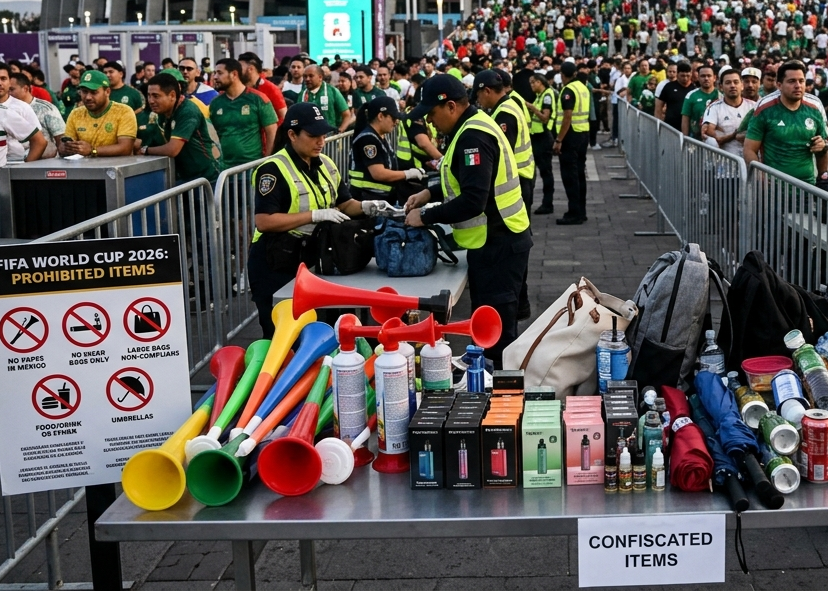
Under that wording, a vape device could be confiscated or refused at the security checkpoint even if the spectator does not intend to use it.
However, the Stadium Code of Conduct creates uncertainty.
Why FIFA’s Vape Device Rules Are Unclear
The FIFA World Cup 2026 Stadium Code of Conduct contains broader rules governing admission, spectator behaviour and prohibited items.
Under its rules concerning dangerous articles, the code reportedly exempts cigarettes and electronic smoking devices from the general prohibition on items that generate smoke, heat or flames. It states that these products may be possessed but not used within the stadium.
A separate section prohibits spectators from:
- Smoking
- Vaping
- Using tobacco products
- Using electronic smoking devices
The code allows possible exceptions only in designated outdoor smoking areas, where such areas exist and are permitted by applicable health and safety rules.
This creates two possible interpretations:
- A spectator may carry a vape device but cannot use it inside the venue.
- A vape device is itself prohibited at entry under FIFA’s newer customer-support guidance.
Because the two documents do not align cleanly, fans should follow the stricter interpretation unless FIFA issues further clarification.
Which FIFA Rule Takes Priority?
The Stadium Code of Conduct states that it applies to World Cup matches and takes precedence over comparable stadium rules during the tournament.
However, FIFA’s matchday-entry guidance also says that FIFA, stadium operators and government authorities retain the final authority to determine whether an item is prohibited.
This means that possession may still be decided at the security checkpoint.
A security official could refuse a vape device based on:
- Updated FIFA instructions
- Venue-specific policies
- Local law
- Host-country restrictions
- Government security requirements
- The type or condition of the device
- Concerns about batteries or liquids
Passing through security at one World Cup stadium does not guarantee that the same device will be accepted at another venue.
What Happens If You Vape Inside a World Cup Stadium?
Violating FIFA’s Stadium Code of Conduct may result in:
- Refusal of entry
- Removal from the stadium
- Confiscation of the device
- Cancellation of the match ticket
- Cancellation of additional tournament tickets
- Reporting to local authorities
- Civil penalties
- Criminal penalties where local law applies
The exact consequence will depend on the circumstances, host country, venue and applicable law.
Even if carrying the device is permitted, using it inside the venue may still result in removal.
Quick Guide for World Cup Fans
| Question | Safest answer |
|---|---|
| Can I vape inside a World Cup stadium? | No |
| Can I smoke cigarettes inside? | No |
| Does the ban cover outer stadium areas? | Yes, if they are within the controlled perimeter |
| Will every venue have a smoking area? | No |
| Can I carry a vape through security? | Do not assume so; FIFA’s documents are inconsistent |
| Can security refuse the device? | Yes |
| Are the laws identical in all three host countries? | No |
| Is bringing a vape into Mexico advisable? | No; official travel guidance says it is illegal |
Is This a New National Vape Ban?
No. FIFA’s stadium restrictions are venue and event rules. They do not, by themselves, change national laws governing the manufacture, importation or sale of vaping products.
FIFA has maintained a tobacco policy for its events for several years. The organisation’s policy states that FIFA events and event sites should be free from tobacco smoke and e-cigarette aerosol, with use restricted to designated areas where available. FIFA Event Policy on Tobacco
The 2026 tournament rules regulate what spectators may do or carry within tournament-controlled areas. They do not automatically:
- Ban vape sales across the United States
- Ban vaping throughout Canada
- Change FDA product authorisation
- Replace provincial Canadian regulations
- Create Mexico’s national vape restrictions
- Establish new rules for airports or airlines
Fans must comply with both the FIFA stadium rules and the law of the host country.
2026 World Cup Vape Rules by Host Country
United States
Vaping laws in the United States involve federal, state and local requirements.
At the federal level, the Food and Drug Administration regulates the manufacture, marketing and distribution of electronic nicotine delivery system products.
As of July 2026, the FDA states that 45 e-cigarette products have received marketing authorisation and are the only e-cigarettes that may currently be lawfully sold in the United States.
That rule relates primarily to legal marketing and sale. It does not necessarily mean that a spectator carrying an unauthorised product will be arrested at a stadium. However, FIFA or stadium security may prohibit the device regardless of its FDA status.
Fans should also consider:
- State indoor vaping laws
- City smoke-free ordinances
- Stadium-specific rules
- Hotel policies
- Public-transport restrictions
- Airline battery requirements
- Minimum-age laws
A vape that is legally purchased in one U.S. state may still be subject to different restrictions in another state or city.
Canada
Canada regulates vaping at federal, provincial, territorial and local levels.
The federal Tobacco and Vaping Products Act governs areas such as manufacturing, labelling, promotion and sale. Health Canada also limits the maximum nicotine concentration of vaping products manufactured or imported for sale to 20 mg/mL.
Provincial and territorial governments regulate many public-use issues, including vaping in:
- Workplaces
- Restaurants
- Bars
- Shopping centres
- Public-transport facilities
- Patios
- Areas near schools
- Vehicles carrying children
- Certain outdoor public spaces
Rules may therefore differ among Canadian host cities.
Health Canada confirms that federal, provincial and territorial authorities share responsibility for tobacco and vaping policy and enforcement. Health Canada regulatory overview
Even if possession is lawful under Canadian law, FIFA can still prohibit the device within a stadium or controlled tournament area.
Mexico
Mexico presents the highest level of risk for World Cup visitors carrying vaping products.
The U.S. Embassy and Consulates in Mexico advise travellers that it is illegal to bring the following products into Mexico:
- Electronic cigarettes
- Vape devices
- Vape pods
- Cartridges
- E-liquids
The embassy advises travellers not to carry these products because they may face entry delays, confiscation, fines or possible criminal charges. U.S. Embassy World Cup travel guidance
This is more than a stadium-entry issue. It applies when entering the country.
A traveller flying from the United States or Canada to Mexico should not assume that a personal-use device is exempt. The safest course is to leave all vaping devices, pods and e-liquids behind.
World Cup Host-Country Comparison
| Country | General legal position | Stadium advice |
|---|---|---|
| United States | Vaping is regulated federally, at state level and locally; only FDA-authorised products may lawfully be sold | Do not use or assume a device can enter |
| Canada | Federal product rules apply alongside provincial, territorial and local public-use restrictions | Check local law, but follow FIFA’s stricter venue rule |
| Mexico | Official travel guidance says bringing vape devices and e-liquids into the country is illegal | Do not travel to Mexico with vaping products |
What About Designated Smoking Areas?
FIFA says designated outdoor smoking areas may be provided depending on the stadium and local regulations.
The phrase “may be available” is important. It does not guarantee that:
- Every venue has a smoking area
- The area permits vaping
- Spectators can leave and re-enter
- The area is available during every match
- Tobacco and electronic cigarettes are treated identically
- The area is outside the security perimeter
Fans should check the individual stadium’s A–Z guide and matchday communications before travelling.
Do not leave the venue expecting to return unless the ticket rules clearly permit re-entry. Many major sporting events do not allow spectators to leave and re-enter after their tickets have been scanned.
Can You Bring a Vape Battery or Empty Device?
FIFA’s guidance refers broadly to “electronic smoking devices.” It does not limit the rule to filled, activated or nicotine-containing devices.
The term could cover:
- Disposable vapes
- Pod systems
- Vape pens
- Box mods
- Heated-tobacco devices
- Empty refillable devices
- Devices without a pod
- Devices containing nicotine-free liquid
Removing the pod or e-liquid may not make the hardware acceptable.
In addition, lithium-ion batteries are subject to separate airline transportation rules. Vape devices and spare batteries are generally not permitted in checked baggage on many airlines, although airline and aviation-authority requirements should be checked before departure.
Airline acceptance does not guarantee stadium acceptance.
What Should Adult Vapers Do Before Attending?
Check FIFA’s Latest Guidance
FIFA may update its entry rules during the tournament. Review the official customer-support page and the A–Z guide for the specific stadium shortly before the match.
Check the Host Country’s Law
Do not rely on the rules from your home country. This is particularly important when travelling to Mexico.
Leave the Device at Your Accommodation
In the United States or Canada, leaving the device in a secure place before travelling to the stadium reduces the risk of refusal or confiscation.
This advice should not be followed in Mexico if it requires bringing the device into the country in the first place.
Do Not Rely on Previous Entry
A device passing security at one match does not establish a right to bring it into another match.
Consider Legal Nicotine Alternatives
Adults who already use nicotine may wish to investigate lawful alternatives such as nicotine gum, lozenges or patches.
However, travellers should confirm whether the specific product is legal in the destination country and permitted under FIFA’s stadium rules. Not every nicotine product is automatically accepted.
Why the Inconsistent Language Matters
Clear prohibited-item rules help spectators prepare and reduce disagreements at security checkpoints.
The difference between “may be possessed but not used” and “prohibited inside the stadium” is significant. One rule permits fans to carry the device; the other allows security to reject it entirely.
The uncertainty could lead to:
- Devices being confiscated
- Delays at stadium entrances
- Inconsistent enforcement
- Disputes between fans and security personnel
- Visitors misunderstanding local law
- Travellers assuming FIFA rules override customs regulations
FIFA could resolve the issue by clearly stating whether electronic smoking devices are prohibited from entry or simply prohibited from use.
Until then, spectators should follow the more restrictive guidance.
Frequently Asked Questions
Can you vape inside a 2026 FIFA World Cup stadium?
No. FIFA prohibits vaping, smoking and the use of electronic smoking devices within stadiums, including controlled inner and outer perimeters.
Can you bring a vape into a World Cup stadium?
The published rules are not completely consistent. FIFA’s customer-support page lists electronic smoking devices as prohibited, while the Stadium Code of Conduct reportedly says they may be possessed but not used. The safest option is not to bring one.
Will World Cup stadiums have smoking areas?
Some venues may provide designated outdoor areas, depending on local law and stadium arrangements. FIFA does not guarantee that every stadium will have one.
Can security confiscate a vape?
Security personnel may refuse entry with a prohibited item. The available response could include requiring the spectator to dispose of or remove the device, although procedures may differ by venue.
Can I take a vape to a World Cup match in Mexico?
Do not do so. Official U.S. Embassy guidance states that bringing e-cigarettes, pods and vaping liquids into Mexico is illegal and may result in confiscation, delays, fines or criminal charges.
Is vaping illegal in Canada?
Vaping products are regulated but are not subject to a complete national possession ban. Public-use restrictions differ by province, territory and municipality. FIFA’s venue prohibition still applies during World Cup matches.
Is vaping illegal in the United States?
Vaping is not subject to a complete national possession ban, but federal, state and local restrictions apply. The FDA regulates which e-cigarette products may be legally marketed.
Does the FIFA rule apply to nicotine-free vapes?
The language covers electronic smoking devices generally and does not provide a nicotine-free exemption. A zero-nicotine device may therefore still be refused.
Does the rule apply to heated-tobacco devices?
Electronic smoking devices and products that heat tobacco may fall within the restriction. Fans should not assume that heated-tobacco devices are exempt.
Final Takeaway
Vaping and smoking are prohibited within 2026 FIFA World Cup stadiums. The remaining uncertainty concerns whether a fan may carry a vape device through security without using it.
FIFA’s customer-support guidance treats electronic smoking devices as prohibited items. The Stadium Code of Conduct appears to allow possession while prohibiting use. Because FIFA, stadium officials and government authorities retain the final decision at entry, spectators should not rely on the more permissive wording.
The simplest approach is:
- Do not vape within a World Cup venue.
- Do not assume that a vape device will pass security.
- Check the latest rules for the specific stadium.
- Follow the laws of the host country.
- Do not bring vaping devices, pods or e-liquids into Mexico.
The FIFA restriction is a tournament venue policy rather than a new national law. Nevertheless, its practical consequences—including refusal of entry, removal or ticket cancellation—can be significant for match-going fans.
Legal disclaimer: This article provides general travel and event information, not legal advice. Stadium policies and national regulations may change. Check official FIFA, customs and government guidance before travelling.